Hip Mobility Exercises: Unlock Pain-Free Movement Fast
If your hips feel tight every time you stand up from your desk or struggle to bend down and tie your shoes, you’re not alone. Hip mobility exercises have become one of the most searched fitness topics in the UK, and for good reason. Years of sitting, driving, and limited movement quietly stiffen the hip joints, leading to lower back pain, poor posture, and restricted athletic performance. This article walks you through why hip mobility matters, the best exercises to restore it, and how to build a sustainable routine that fits into everyday life. Whether you’re an athlete chasing better squat depth or simply someone who wants to walk without discomfort, you’ll find practical, expert-backed guidance here that goes beyond generic stretching advice.
Why Hip Mobility Matters More Than You Think
The hip joint is one of the most complex and load-bearing structures in the human body, connecting the upper body to the lower limbs through a ball-and-socket design. When this joint loses its natural range of motion, the effects ripple outward into the knees, lower back, and even the shoulders, as the body compensates for what the hips can no longer do. Many people assume hip stiffness is simply a sign of ageing, but in reality, it’s largely a consequence of modern lifestyle habits rather than an inevitable decline. Sitting for prolonged periods shortens the hip flexors and weakens the glutes, creating a muscular imbalance that limits movement long before age becomes a factor.
Poor hip mobility doesn’t just affect athletes or gym-goers; it influences how efficiently you walk, climb stairs, and even sleep. Restricted hips force the lumbar spine to take on extra rotational and flexion stress, which is a leading contributor to chronic lower back pain in adults. Over time, this compensation pattern can lead to recurring injuries, reduced athletic output, and a general sense of stiffness that people often mistake for normal ageing rather than a fixable mobility issue.
The encouraging news is that hip mobility is highly trainable at almost any age or fitness level. Unlike some structural limitations, restricted hip range of motion typically responds well to consistent, targeted movement work. Research in sports medicine and physiotherapy consistently shows that a structured mobility routine, performed just a few times a week, can noticeably improve range of motion, reduce pain, and enhance functional movement patterns within a matter of weeks. This makes hip mobility exercises one of the highest-value additions you can make to any fitness or recovery routine.
Understanding the Hip Joint and Common Causes of Stiffness
To improve hip mobility effectively, it helps to understand what’s actually happening inside the joint. The hip is surrounded by several major muscle groups, including the hip flexors, glutes, adductors, and deep rotators, all of which must work together to allow smooth, multidirectional movement. When one group becomes tight or another becomes weak, the joint compensates by restricting its own range of motion as a protective mechanism. This is why stretching alone often fails to solve hip stiffness long-term; the underlying strength and coordination issues remain unaddressed.
Sedentary behaviour is the most common cause of reduced hip mobility in the UK population today, particularly among office workers and frequent drivers. Sitting in a flexed hip position for eight or more hours a day trains the hip flexors to remain shortened, while simultaneously deactivating the glute muscles responsible for hip extension. Over months and years, this creates what physiotherapists often call “hip flexor dominance,” a pattern where the front of the hip overworks while the back underperforms, leading to stiffness, discomfort, and reduced power output during physical activity.
Other contributing factors include previous injuries, repetitive movement patterns from sports like running or cycling, and simply a lack of variety in daily movement. Many people move almost exclusively in straight lines, forward and backward, while rarely incorporating rotational or lateral movement into their day. Since the hip joint is designed for multidirectional motion, this lack of variety gradually narrows its functional range. Understanding these root causes is essential, because it shifts the goal from temporary stretching to building genuine, lasting hip mobility through targeted exercise.
The Best Hip Mobility Exercises to Start With
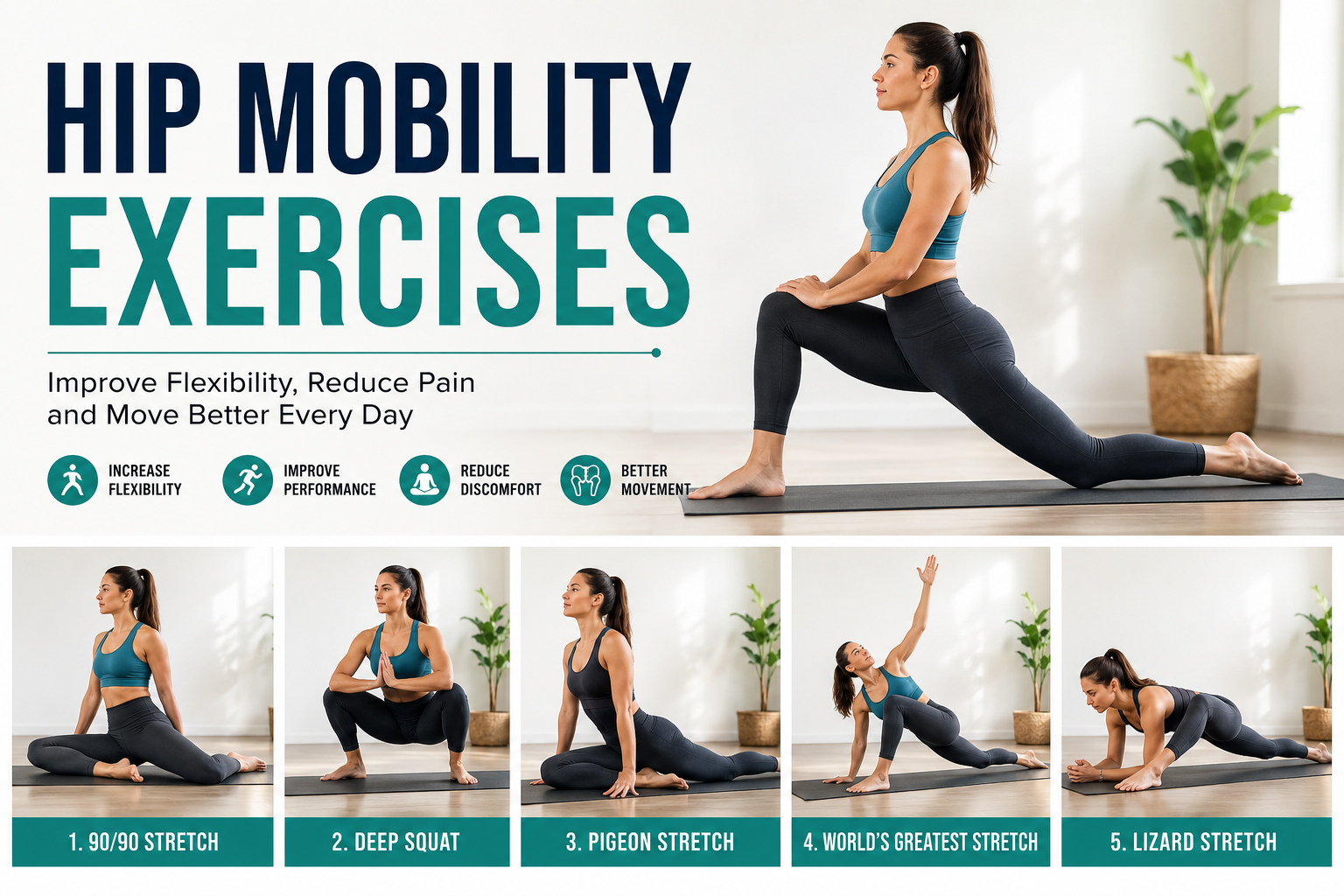
A well-rounded hip mobility routine should address flexibility, strength, and joint control simultaneously, rather than focusing on stretching alone. The 90/90 hip stretch is widely regarded as one of the most effective exercises for this purpose, as it actively trains internal and external rotation, a range of motion most people severely lack. Performed by sitting with one leg bent in front at ninety degrees and the other bent behind at the same angle, this exercise targets both the external rotators and the deep hip capsule, making it a foundational movement for almost any mobility programme.
The world’s greatest stretch, despite its dramatic name, lives up to its reputation by combining a deep lunge with a rotational reach toward the ceiling. This single exercise stretches the hip flexors, opens the thoracic spine, and engages the glutes and core simultaneously, making it incredibly efficient for time-conscious individuals. Another highly effective movement is the deep squat hold, sometimes called the “Asian squat,” which trains ankle, knee, and hip mobility together while building the strength needed to maintain that range under load. Holding this position for thirty to sixty seconds daily can produce noticeable improvements within just a few weeks.
Hip circles and leg swings, though often dismissed as basic warm-up movements, play a crucial role in lubricating the joint and improving active range of motion before exercise. Dynamic movements like these increase synovial fluid circulation within the joint capsule, reducing friction and preparing the muscles for more demanding work. Pairing dynamic movements like hip circles with static holds such as the pigeon pose or kneeling hip flexor stretch creates a balanced approach that addresses both mobility and stability, which is the combination most experts agree produces the best long-term results.
Building an Effective Weekly Hip Mobility Routine
Consistency matters far more than intensity when it comes to improving hip mobility, which is why building a realistic weekly routine is essential for lasting results. Most physiotherapists recommend performing hip mobility exercises at least four to five times per week, ideally as part of a morning routine or pre-workout warm-up. A session doesn’t need to be lengthy to be effective; even ten to fifteen minutes of focused movement can produce meaningful improvements when done consistently over several weeks rather than sporadically.
A practical approach is to structure sessions around three categories: dynamic warm-up movements, static stretches, and strength-based mobility work. Beginning with dynamic exercises like leg swings and hip circles prepares the joint for movement, while static stretches such as the 90/90 or pigeon pose target specific areas of tightness. Finishing with strength-focused movements, such as glute bridges or controlled deep squats, reinforces the new range of motion by teaching the muscles to control it under load, which is often the missing piece in routines that rely solely on stretching.
It’s also important to listen to the body and progress gradually rather than forcing depth or flexibility too quickly. Mobility work should never cause sharp pain; mild discomfort during a stretch is normal, but sharp or pinching sensations indicate the body isn’t ready for that range yet. Tracking progress through simple markers, such as how comfortably you can sit in a deep squat or how far you can rotate your hip without discomfort, provides motivating feedback that keeps people consistent. Over time, this structured, patient approach yields far better results than aggressive stretching sessions performed only occasionally.
Hip Mobility for Athletes, Runners, and Everyday Movement
For runners and athletes, hip mobility directly influences stride length, power output, and injury risk, making it a non-negotiable part of training rather than an optional extra. Limited hip extension forces runners to compensate through excessive lower back arching or shortened strides, both of which reduce efficiency and increase strain on surrounding joints. Incorporating hip mobility exercises into a warm-up routine before runs or training sessions has been shown to improve stride mechanics and reduce the likelihood of common overuse injuries affecting the knees and lower back.
Strength athletes, particularly those who squat or deadlift regularly, also benefit enormously from improved hip mobility, as it directly affects depth, bar path, and joint loading during compound lifts. Tight hips often force compensatory patterns during a squat, such as the knees caving inward or the lower back rounding at depth, both of which increase injury risk over time. By dedicating consistent time to hip mobility exercises, lifters often notice improved squat depth, better movement symmetry, and reduced discomfort during heavy training sessions within just a few weeks of consistent practice.
Beyond sport-specific performance, hip mobility plays an underrated role in everyday quality of life, particularly as people age. Simple tasks like getting up from the floor, climbing stairs, or bending to pick something up all depend on functional hip range of motion. Maintaining this mobility throughout adulthood reduces fall risk, supports independence in later years, and helps prevent the gradual stiffness that many people mistakenly accept as an unavoidable part of getting older. This makes hip mobility exercises valuable not just for athletes, but for anyone who wants to move confidently throughout life.
Common Mistakes That Limit Hip Mobility Progress
One of the most frequent mistakes people make is treating hip mobility exercises as a one-time fix rather than an ongoing practice, expecting a single stretching session to undo years of stiffness. Mobility is a skill that the nervous system gradually adapts to, meaning real, lasting change requires repeated exposure over weeks and months, not days. Abandoning a routine after a few sessions because results aren’t immediately visible is one of the biggest reasons people fail to see long-term improvement in their hip function.
Another common error is focusing exclusively on flexibility while neglecting strength within the new range of motion. Stretching a muscle without subsequently strengthening it in that lengthened position often leads to instability, which the body responds to by tightening up again as a protective measure. This is why combining static stretches with strength-based mobility exercises, such as controlled squats or single-leg work, produces far more durable results than stretching alone. Genuine mobility isn’t just about how far a joint can move, but how much control and strength is available throughout that entire range.
Finally, many people overlook the role of surrounding muscle groups, particularly the core and ankles, in supporting healthy hip function. Poor core stability often forces the hips to compensate for lack of trunk control, while limited ankle mobility can restrict how deeply the hips are able to move during squatting patterns. A truly effective hip mobility routine, therefore, considers the entire kinetic chain rather than isolating the hip joint alone. Addressing these interconnected areas alongside dedicated hip mobility exercises leads to more complete, lasting improvements in overall movement quality.
Final Thoughts on Improving Hip Mobility
Improving hip mobility isn’t about chasing dramatic flexibility for its own sake; it’s about restoring natural, pain-free movement that supports everything from daily tasks to athletic performance. The exercises and principles outlined in this article, ranging from the 90/90 stretch to strength-based mobility work, offer a comprehensive starting point for anyone dealing with hip stiffness or looking to prevent it. What matters most is consistency, patience, and a willingness to combine flexibility work with strength, rather than relying on stretching alone.
As with any physical training programme, individual results will vary depending on starting mobility, lifestyle, and any pre-existing conditions, so progressing gradually and listening to your body remains essential throughout the process. Building a simple, realistic routine that fits into your week is far more valuable than an intense programme you abandon after a few days. With regular practice, most people notice meaningful improvements in how their hips feel and function within just a few weeks. Start small, stay consistent, and let your hips move the way they were always designed to.